



This guide covers the best email marketing software for ecommerce. You'll learn what makes each platform different and how to choose platforms that drive sales through product-based automation. We cover everything from Shopify-native platforms to general email tools that integrate well with eCommerce, focusing on what drives revenue.
Ecommerce email marketing needs specific features: product data integration, dynamic content blocks that show real products, automation triggered by shopping events (views, carts, purchases), revenue attribution that proves ROI.
Most email marketing platforms weren't built for eCommerce. They can't pull in real product data, trigger automation based on shopping behavior, or show which emails actually drive sales. You end up sending generic promotional emails instead of personalized, product-based campaigns that convert.
TL;DR: eCommerce-Focused Email Marketing Software
If you have an store on Shopify, WooCommerce, or any other major eCommerce platform, any of these email marketing tools can work.
| Feature | Klaviyo | Omnisend | Mailchimp | Drip | Privy | Bento |
|---|---|---|---|---|---|---|
| Ideal For | Scaling brands ($10k+/mo) needing advanced, data-driven marketing. | Small to medium stores wanting an all-in-one email & SMS platform. | Beginners or those already on Mailchimp needing a general tool. | Sophisticated marketers ($25k+/mo) needing maximum automation control. | Stores focused on aggressive list growth via popups and forms. | Technical marketers & startups wanting a flexible, fair-priced platform. |
| Free Plan | Yes, up to 250 contacts & 500 emails/mo. 1 | Yes, up to 250 contacts & 500 emails/mo. 2 | Yes, up to 500 contacts & 1,000 emails/mo (with daily limits). 3 | No, 14-day free trial only. 4 | Yes, up to 100 mailable contacts. 5 | Coming soon plus free month trial for everyone. 6 |
| Starting Price | $20/month | $11.20/month | $6.5/month | $39/month | $30/month | $30/month |
| Email Send Limit | 10x contact limit on paid plans. 1 | Standard: 12x contact limit. Pro: Unlimited. 7 | Varies by plan (10x-15x contact limit). 3 | Unlimited | Unlimited | Unlimited |
| Ecommerce Automation | ✅ Advanced (Pre-built flows, predictive analytics) | ✅ Strong (Pre-built flows, email + SMS) | ✅ Basic (Requires more manual setup) | ✅ Advanced (Most powerful visual workflow builder) | ✅ Strong (Covers essentials well) | ✅ Strong (Visual workflows, behavioral triggers) |
| Advanced Segmentation | ✅ Excellent (Purchase history, browsing behavior, LTV) | ✅ Good (Behavioral, engagement, shopping activity) | ✅ Basic (Requires manual tagging and setup) | ✅ Excellent (Unlimited custom fields, hyper-personalization) | ✅ Basic (Signup source, purchase history) | ✅ Excellent (Anonymous & identified event tracking) |
| SMS Marketing | ✅ Native (Add-on cost) | ✅ Native (Included in Pro plan) | ✅ Native (Add-on cost) | ✅ Native (Add-on cost) | ✅ Native (Add-on cost) | Via Twilio Integration (Requires separate Twilio account). 8 |
| Popups & Forms | ✅ Good (Built-in) | ✅ Strong (Gamified forms like spin-to-win) | ✅ Basic (Functional but not a core strength) | ✅ Good (Onsite personalization) | ✅ Excellent (Best-in-class popup builder & targeting) | ✅ Strong (Popups, forms, and live chat included) |
| Shopify Integration | Deep | Deep | Good | Deep | Deep | Deep |
Klaviyo is the industry standard for scaling ecommerce brands that are serious about data-driven marketing. It is best for stores with established revenue (typically $10,000+/month) that need powerful automation, granular customer segmentation based on browsing and purchase history, and detailed revenue attribution. While it has a steeper learning curve and a higher price point, its deep integration with Shopify makes it the top choice for ambitious stores.
Omnisend is the best all-in-one marketing platform for small to medium-sized ecommerce stores that want to combine email and SMS marketing. It offers a user-friendly interface, pre-built ecommerce automations, and a generous free plan that includes up to 250 contacts and 500 emails per month. It is a strong, affordable alternative to Klaviyo for stores that want powerful features without the steep learning curve.
Mailchimp is a good starting point for new ecommerce stores or those already familiar with its platform. While its Shopify integration has improved and it now offers more ecommerce-specific features, it remains a general email marketing tool rather than a specialist platform. It is a user-friendly option for those who need a versatile tool for more than just ecommerce.
Drip is a premium ECRM (ecommerce CRM) for sophisticated marketers who want maximum control and powerful automation. It excels at complex, multi-step workflows and deep personalization. With no free plan and a starting price of $39/month, it is best suited for established brands (typically $25,000+/month) that view email marketing as a primary growth engine.
Privy has evolved from a list-building tool to a complete email and SMS marketing platform. It still has a strong focus on conversion tools like pop-ups and spin-to-win forms, making it ideal for stores prioritizing list growth. Its email marketing features are now more robust, making it a solid all-in-one choice for small to medium-sized stores that want to combine aggressive list-building with email and SMS marketing.
Bento is the only all-round email marketing platform on this list because it's our blog (hah!). Bento has native integrations with Shopify, WooCommerce, Magento, and other eCommerce platforms. Everything Klaviyo and Omnisend can do, so can Bento. Where Bento beats the competition is value for money. Not only do we cost less per subscriber in general and are more affordable at scale, we offer complete and unlimited access to ALL of our features under one subscription plan. For example, many email marketing platforms limit your number of email sends per month to 10X the number of contacts. Bento lets you send unlimited emails.
What to watch out for: Not all email marketing platforms understand ecommerce. Platforms built for content creators or B2B marketing don't have product data integration, dynamic product blocks, or ecommerce-specific automation. Choose platforms built for online stores, not adapted for them.
Later in this guide, I cover what makes ecommerce email marketing effective. You'll see why platforms that handle both product automation and deliverability often perform better. For behavioral targeting comparisons, see behavioral targeting tools. For automation workflows, check email automation software.
Why Ecommerce Email Marketing Is Different
Ecommerce email marketing requires specialized tools for several key reasons.
Product data makes the difference. Your email platform needs to know product names, prices, images, availability, and variants. General email platforms can't pull in real product information dynamically. This limits personalization to basic merge tags instead of showing actual products people browsed.
Shopping behavior drives automation and good ecommerce automation triggers on specific actions. Someone views a product, adds to cart, makes a purchase, browses categories - platforms that can't track these events miss out on the automation that actually converts.
Dynamic content sells products. Think about it. Product recommendations, recently viewed items, abandoned cart products - these all need dynamic content blocks that pull in real product data. Static email templates can't do personalized product content.
Revenue tracking proves what works. You need to know which emails drive sales, not just opens or clicks. Platforms that integrate with ecommerce data can attribute revenue to specific campaigns. This makes optimization actually possible instead of guessing.
Cart abandonment recovery brings easy wins. Recovering abandoned carts is one of the highest-ROI email tactics for ecommerce. But your platform needs to detect cart abandonment automatically. Then trigger sequences with actual cart contents, not generic "you left something behind" messages.
Here's the reality. General email marketing platforms can send promotional emails to ecommerce stores. But they can't leverage product data, shopping behavior, or purchase history effectively. You need platforms built for online stores specifically.
How to Choose Ecommerce Email Marketing Software
You've got dozens of options. Here's what actually matters when picking one:
Ecommerce Integration Depth
First, check platform integration. Does it work natively with Shopify, WooCommerce, or BigCommerce? Deep integration matters more than just connecting. You need automatic syncing of product data, customer data, and order data.
Product data access is crucial. The platform should pull product names, prices, images, variants, and availability. Not just once, but dynamically for each email. If it can't show real products in emails, move on.
Customer data needs to sync automatically too. Purchase history. Browsing behavior. Cart contents. You should be able to segment based on what people bought, what they looked at, or how much they spend.
Ecommerce-Specific Features
Cart abandonment recovery should be automatic. The platform detects abandoned carts, triggers sequences, and includes actual cart contents. Generic "you forgot something" emails don't convert.
Product recommendations need to be smart. It should be based on browsing history or past purchases, and it should be updated dynamically with real product data. Not just "bestsellers" shown to everyone.
Browse abandonment catches window shoppers. Someone views products but doesn't add to cart. The platform should trigger emails with those specific products they viewed.
Post-purchase sequences keep customers coming back. You should send follow-up emails after purchases, cross-sells of related products and review requests at the right time.
Win-back campaigns re-engage dormant customers. Identify who hasn't purchased recently and send relevant products based on their history. Not just discount blasts to everyone.
Automation Capabilities
Look at available triggers - product views, cart additions, purchases, category browsing, order status changes. The more triggers, the more sophisticated your automation can be.
Dynamic content separates good platforms from great ones. Email content should change based on who's receiving it. Different products for different people. Personalized based on their behavior.
Segmentation needs to be granular. Not just "customers" and "non-customers." Segment by purchase frequency, average order value, product categories bought, lifetime value. The more specific, the better.
Revenue and Analytics
Revenue attribution shows what actually works. Which emails drive sales, not just clicks. Which automations generate revenue. Which segments are most valuable.
Product performance tracking helps optimize. See which products sell through email. Which ones get clicked but not bought. Use this data to improve recommendations.
Customer insights drive strategy. You need to understand lifetime value purchase frequency, product preferences, and use these insights to send better emails.
What Actually Matters
Here's the truth. Most stores don't need every bell and whistle. You need deep integration with your ecommerce platform. Product-based automation that works. Revenue attribution to prove ROI. Pick based on features you'll actually use, not what sounds impressive in a demo.
Deep Dive: The Best Ecommerce Email Marketing Platforms
Time for specifics. Here's what each platform actually does well (and where they fall short):
Klaviyo: The Ecommerce Powerhouse

Who it's for: Online retailers, Shopify stores, brands doing significant revenue from email marketing.
Klaviyo was built for ecommerce from day one. It shows in everything they do. The platform triggers emails based on actual shopping behavior. Someone views a product, abandons a cart, makes a purchase. Klaviyo tracks it all and responds automatically.
The Shopify integration goes deep. Product data, customer data, order data all sync without you lifting a finger. Build emails with dynamic product blocks. They pull in real product names, prices, images, variants. This makes true personalization possible at scale.
Cart abandonment sequences show actual cart contents. Browse abandonment emails display products someone viewed. Post-purchase sequences cross-sell related items. Predictive analytics spot customers likely to buy again or churn.
Revenue attribution tells you exactly which emails drive sales. Not clicks. Sales. The platform tracks product-level performance too. You'll know which products convert best through email.
The downsides: Klaviyo gets expensive fast. They charge based on contacts, not emails sent, but you pay for everyone on your list whether you email them or not. At scale, expect $1,000+ monthly for large lists.
The platform assumes you run ecommerce. Selling services or running a different business? Many features become overkill.
Pricing reality: Free plan covers 250 contacts. Paid plans start around $20/month for up to 500 contacts. You'll need $425+/month once you hit 25,000 contacts.
Bottom line: Got the budget and serious about ecommerce email? Klaviyo delivers. The product automation and revenue tracking work extremely well. Just be ready to pay for it.
Omnisend: Affordable Ecommerce Automation
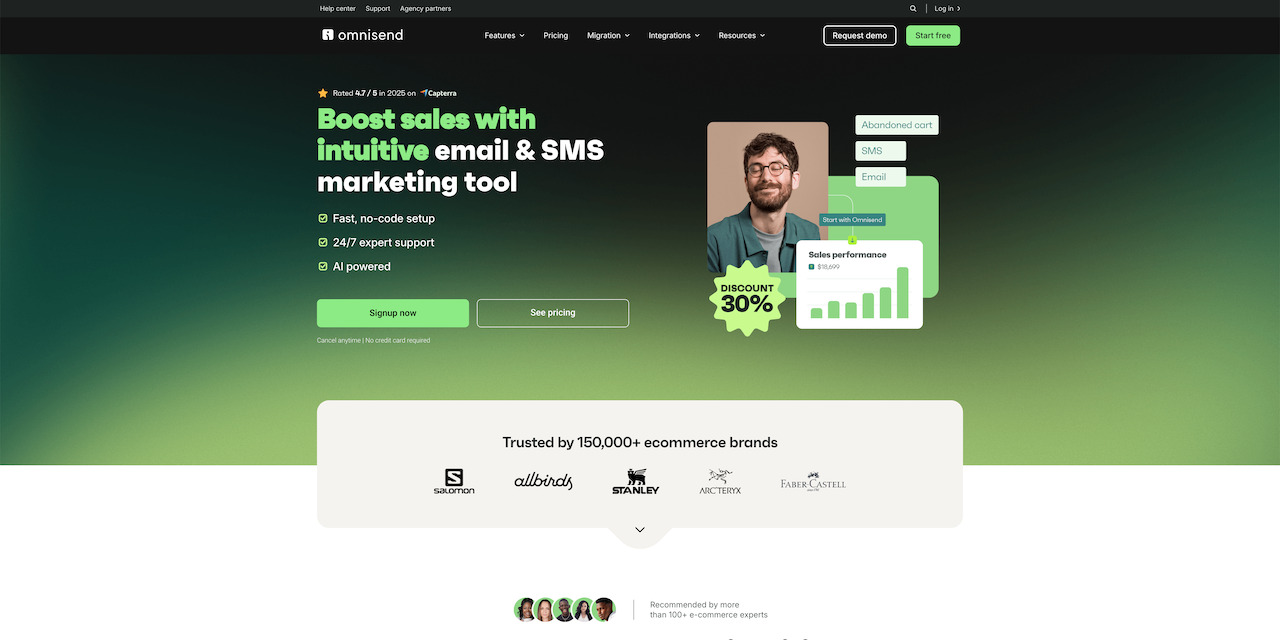
Who it's for: Small ecommerce stores needing product automation on tight budgets.
Omnisend built their platform for ecommerce, even the free plan shows it. You get email automation with 20+ pre-built ecommerce flows. Customer segmentation designed for retail. Abandoned cart emails included.
The campaign builder has 250+ templates made for online stores. Segmentation comes with pre-built segments. Frequent buyers. High-value customers. At-risk subscribers. It's all there.
Ecommerce integrations work smoothly. Shopify, WooCommerce, BigCommerce all connect well. Product data syncs. Cart abandonment detection works. You can build emails with dynamic product blocks.
The downsides: Free plan limits hurt - just 250 subscribers and 500 emails monthly. Automation lacks Klaviyo's sophistication. You get pre-built flows but less custom flexibility.
Fewer people use Omnisend than Klaviyo, so there is less community support and fewer tutorials. Advanced features aren't as robust as premium platforms.
Bottom line: Running a small store? Can work within 250 subscribers initially? Omnisend makes sense. The ecommerce features work well. Paid plans start at just $16/month.
Mailchimp: All-in-One with Ecommerce Features
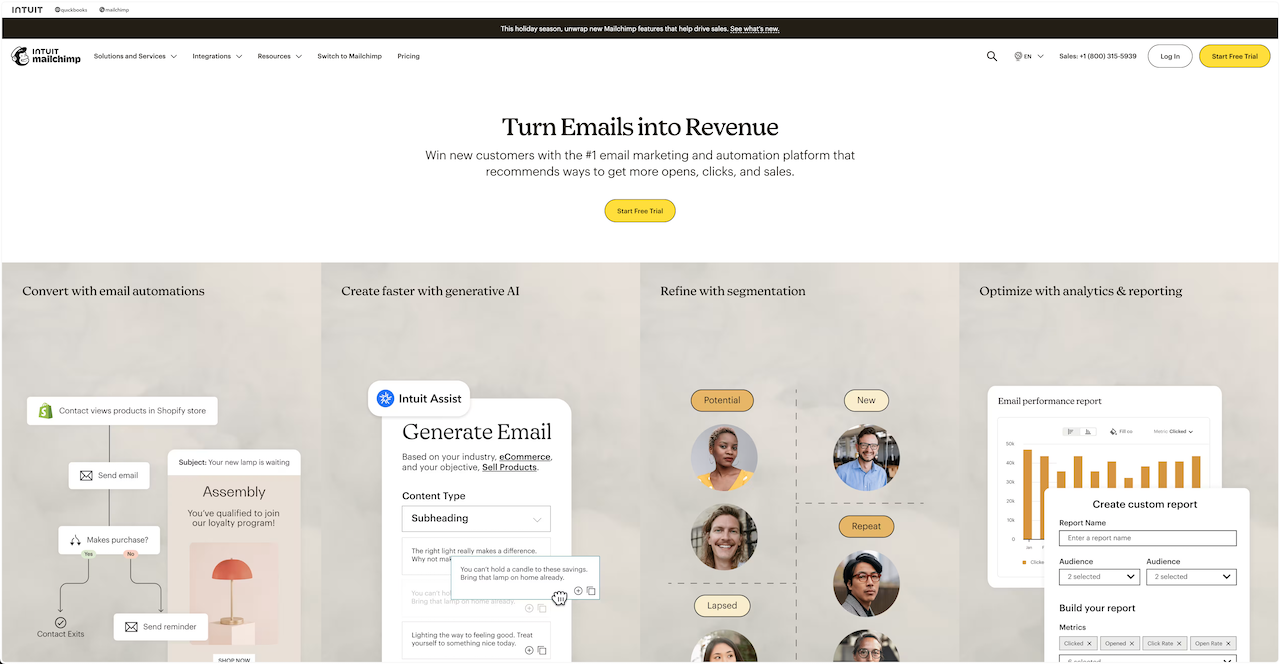
Who it's for: Small stores wanting all-in-one marketing plus basic ecommerce email.
Mailchimp wasn't built for ecommerce, but they've added features. Shopify integration works okay. Product data syncs. Basic cart abandonment exists.
The platform stays user-friendly. Non-technical team members can manage campaigns easily. Templates include ecommerce designs. The automation builder handles basic workflows.
The downsides: Ecommerce features stay basic compared to specialists and product data integration is surface-level. Dynamic product blocks are limited. Revenue attribution can't match Klaviyo.
Mailchimp tries to serve everyone. That means nothing is optimized for ecommerce specifically. You're forcing a general platform to work for your store.
Bottom line: Want all-in-one marketing with email, landing pages, social ads? Need just basic ecommerce features? Mailchimp works. But serious product automation or revenue tracking? Look elsewhere.
Drip: Advanced Ecommerce Segmentation

Who it's for: Ecommerce brands wanting advanced features without Klaviyo prices.
Drip built advanced automation for ecommerce specifically. Behavioral triggers track everything. Product views, cart additions, purchases, browsing patterns. Build workflows based on actual shopping behavior.
The visual workflow builder makes sense of complex automation. See entire flows clearly. Watch how customers move through campaigns. Pre-built templates cover the basics. Cart abandonment, post-purchase, win-back campaigns.
Ecommerce integrations work smoothly. Product data syncs properly. Dynamic product content displays correctly.
The downsides: Fewer people know Drip than Klaviyo, which, again means less community support and fewer existing tutorials. Pricing isn't transparent like competitors. The platform focuses on ecommerce, making it less ideal for other businesses.
Bottom line: Want advanced automation without Klaviyo's price? Drip delivers. Less popular but features work well for sophisticated ecommerce email.
Privy: Popups + Email Marketing

Who it's for: Stores focused on growing their email list.
Privy does popups better than email. Powerful popup tools. Exit-intent triggers. Capture forms that convert. Shopify integration makes capturing emails easy at the right moments.
Email marketing comes included. Send campaigns. Basic automation. But list building is where Privy shines, not email sophistication.
The downsides: Email features can't compete with dedicated platforms. The automation is very basic and there is limited product data integration. Ecommerce features aren't sophisticated.
Bottom line: Need to grow your list fast? Privy works great. Need sophisticated email automation? Pick something else.
Why Smart Ecommerce Brands Choose Bento

You've looked at the alternatives. Here's why Bento wins.
The other platforms have a deliverability problem. Klaviyo, Omnisend, Mailchimp — they all focus on features first and bolt on sending infrastructure as an afterthought. Your cart abandonment sequences, welcome series, and flash sale campaigns create massive volume spikes. Their systems weren't built to handle them cleanly. The result? Emails land in spam. Revenue disappears. Bento includes deliverability from day one. Reputation monitoring, authentication setup, and intelligent batching all built in. We spread your sending volume naturally so your emails actually reach the inbox. A perfect automation flow is worthless if it ends up in junk.
Ecommerce integration that goes all the way. Bento connects with Shopify, WooCommerce, and BigCommerce. Product data syncs, customer data syncs, order data syncs. Build cart abandonment sequences with actual cart contents. Trigger automations on real shopping behavior — product views, cart additions, purchases, category browsing. Segment by what people buy, what they browse, how much they spend. Dynamic content blocks pull product information automatically. Revenue attribution shows you which emails drive sales, not just opens.
You see the full customer journey. Most platforms are blind until someone signs up. Bento tracks anonymous visitors from the moment they land on your site. That means your automations can start earlier, your segmentation runs deeper, and your personalization hits harder than anything Klaviyo can offer at the same price point.
Pricing that doesn't punish growth. Klaviyo charges you for every contact on your list, whether you email them or not, so their pricing model is designed to get expensive fast. Bento charges a simple, predictable rate per active user with unlimited email sends and every feature included from day one. No tiers, no gates and no upgrade fees to unlock the tools you actually need. A list of 10,000 contacts costs $100/month. That's it.
When Bento is the obvious choice: You run a serious ecommerce store. You want deep product automation and deliverability that doesn't need babysitting. You're tired of paying for contacts you don't email. You want all the features, not just the ones your pricing tier allows. Deliverability is your priority.
When a competitor might fit better: You have an unlimited budget and need Klaviyo's most advanced predictive analytics. You're just starting out and want the absolute simplest tool for a few months while you find your feet.
The bottom line: Every platform on this list can send an email. Most of them can build a cart abandonment flow. But only Bento combines deep ecommerce automation, built-in deliverability infrastructure, anonymous visitor tracking, and transparent pricing that scales fairly. You're not paying the Klaviyo tax. You're not settling for Omnisend's limitations. You're getting the platform that was built to do the whole job properly.
Ready to Build Ecommerce Email That Drives Sales?
Start with integration that goes deep. Your platform needs to connect properly with Shopify, WooCommerce, or BigCommerce, and not just on surface level. Product data, customer data, order data all need to sync automatically. Without deep integration, you can't use shopping behavior to drive automation.
Focus on automations that make money. Cart abandonment often drives more revenue than all your promotional campaigns combined. Browse abandonment catches people before they forget. Post-purchase sequences turn one-time buyers into repeat customers. Build these first, measure results, and then expand.
Use real product data for personalization. Generic "check out our sale" emails get deleted. But showing the exact product someone viewed yesterday? That gets clicks. Pick platforms with dynamic product content. Show what people actually browsed, not random recommendations.
Track revenue, not vanity metrics. Opens don't pay bills and clicks don't either. You need to know which emails drive actual sales. Platforms with proper revenue attribution show you what works. Then you can do more of it.
Remember deliverability matters. The best automation fails in the spam folder. Pick platforms that handle both ecommerce features and deliverability. Don't treat it as an afterthought. For more on deliverability, check our email deliverability tools guide.
More resources to help: Add behavioral triggers with our behavioral targeting tools guide. Compare automation platforms in our email automation software review. For broader platform comparisons, see best email marketing services.
Every platform we covered does something well. Klaviyo delivers advanced automation if you can afford it. Omnisend gives small stores affordable features. Mailchimp provides all-in-one simplicity. Drip offers sophisticated segmentation. Seguno keeps Shopify integration simple. Bento combines ecommerce automation with deliverability infrastructure.
Pick based on what you actually need. Integration depth that matches your platform. Features you'll use, not ones that sound impressive. Built-in deliverability if inbox placement matters.
Ready to explore ecommerce email that combines automation with deliverability? Bento can help.

