



You sign up for HubSpot's free plan; it's clean, capable, and everything seems manageable. Then your team grows. You need automation, you have more contacts, you start needing a feature that's locked behind the Professional tier. The quote comes back: $890 per month, plus a mandatory $3,000 onboarding fee1. For a business that was paying $20 a month last quarter, that number stops conversations cold.
This is the experience that sends thousands of businesses searching for HubSpot alternatives every year. It's not that HubSpot is a bad product. The platform is genuinely powerful and has earned its reputation. The problem is that HubSpot is designed to grow with you in a very specific way: by charging you more at every stage. They charged more contacts, more seats, more hubs, more add-ons. By the time you have a modestly-sized team with a reasonably-sized list, the bill can look more like enterprise software than the scrappy tool you started with.
The good news is that the market has never offered more compelling alternatives. Whether you need a focused email marketing platform, a sales-driven CRM, or a modern all-in-one tool that doesn't punish you for growing, there is a solution that fits your business and your budget. This guide covers the best HubSpot alternatives in 2026, with an honest look at what each one does well and who it's best suited for.
TL;DR: Top HubSpot Alternatives
- Bento is the best all-around alternative for businesses that want modern automation, transparent pricing, and a platform that doesn't charge per seat or per feature tier.
- ActiveCampaign is the strongest choice for teams that need deep, sophisticated marketing automation workflows.
- Mailchimp remains the most accessible entry point for businesses focused primarily on email campaigns.
- Zoho CRM offers the widest feature set for the price, making it ideal for budget-conscious teams that need everything in one place.
- Pipedrive is purpose-built for sales teams that live and die by their pipeline.
- EngageBay is the most generous free option for startups that need CRM, marketing, and support tools without an upfront investment.
- Brevo is the best choice for businesses that want to combine email, SMS, and chat under one roof at a low cost.
The Hidden Costs of HubSpot
HubSpot's pricing structure is more complicated than it first appears. The platform is split into six separate product hubs — Marketing, Sales, Service, Content, Operations, and Commerce — each with its own Starter, Professional, and Enterprise tiers1. On the surface, this modularity seems flexible. In practice, most businesses need features from multiple hubs, and the costs compound quickly.
The most significant friction point is the jump from Starter to Professional. HubSpot's Marketing Hub Starter starts at $20 per seat per month, which feels reasonable. But the moment you need marketing automation beyond basic sequences, A/B testing, or advanced reporting, you're pushed to the Professional plan at $880 per month — plus a one-time onboarding fee of around $3,000 that is not optional1. That's a jump from roughly $240 per year to over $13,000 per year, before you've added a single extra contact or user.
The contact-based pricing adds another layer of cost. On the Professional plan, you start with 2,000 marketing contacts. Every additional 5,000 contacts costs between $150 and $250 per month1. For a business with a list of 20,000 contacts, that's potentially $900 in contact fees on top of the base plan price. Add a few extra seats at $45 per user per month, and the total cost of ownership becomes genuinely difficult to predict.
Many businesses also find themselves paying for features they never use. HubSpot's breadth is part of its appeal, but it also means the platform is dense with functionality that requires significant time to learn and configure. Teams that only need email marketing and a basic CRM often end up subsidizing a website builder, a content management system, and an operations hub they have no use for.
Top HubSpot Alternatives for 2026
Bento: The Modern, AI-Powered Choice

Bento is the HubSpot alternative that most directly addresses the pricing and complexity complaints that drive businesses away from HubSpot in the first place. Trusted by over 4,000 businesses and rated 4.9 out of 5 on G2, Bento has built a reputation as the platform that gives you everything you need without the feature bloat, the per-seat fees, or the confusing hub structure2.
The core of Bento's appeal is its pricing model. Rather than gating features behind expensive tiers, Bento charges based on the number of identified users in your system. The Starter plan is a flat $30 per month for up to 3,000 users, with all features included from day one. The Growth plan scales at $0.01 per user per month — meaning 10,000 users costs $100 per month, and 50,000 users costs $500 per month2. There are no surprise overages, no mandatory onboarding fees, and no add-ons required to unlock automation or analytics.
On the feature side, Bento covers the full stack: visual workflow automation, broadcast email campaigns, transactional email, a built-in AI CRM, shared inboxes for team communication, lead scoring, A/B testing, and real-time analytics. The platform also includes anonymous and identified event tracking, which allows you to build automation sequences that respond to user behavior before and after signup — a capability that HubSpot reserves for its higher-tier plans2.
Bento's automation builder is designed to be genuinely usable. The visual workflow interface supports behavioral triggers, conditional logic, drip campaigns, and lifecycle campaigns without requiring a dedicated marketing operations specialist to configure them. The platform also includes a Spam API for email validation, RSS and JSON support for dynamic content, and an MCP integration for AI-powered workflow management.
For teams switching from HubSpot, Bento offers full migration assistance, with most migrations completed within 24 to 48 hours and zero data loss guaranteed. The platform's Discord community and direct founder support are consistently cited by users as standout differentiators in an industry where customer service is often an afterthought.
Best for: Startups, SaaS companies, and growing SMBs that want a modern, all-in-one email marketing and CRM platform with transparent pricing and no per-seat fees.
Pricing: Starter at $30/month (up to 3,000 users, all features included); Growth at $0.01 per user per month; Enterprise pricing available on request.
ActiveCampaign: The Automation Powerhouse

ActiveCampaign has long been the benchmark for marketing automation depth. Its workflow builder is widely regarded as the most powerful in its class, offering drag-and-drop functionality, an extensive library of triggers and conditions, and the ability to build multi-branch automation sequences that would require significant custom development to replicate elsewhere3.
Where ActiveCampaign excels is in the granularity of its automation logic. You can trigger workflows based on email engagement, site visits, purchase history, CRM stage changes, and custom event data. The platform's CRM is tightly integrated with its marketing tools, making it possible to build sequences that hand leads from marketing to sales automatically based on behavioral signals. Lead scoring, predictive sending, and conditional content are all available on mid-tier plans.
The trade-off is cost. ActiveCampaign's Starter plan begins at $15 per month for 1,000 contacts, but the features that make the platform genuinely powerful — unlimited automations, landing pages, and predictive sending — are locked behind the Plus and Pro plans, which start at $49 and $79 per month respectively for 1,000 contacts3. At 10,000 contacts, the Pro plan costs $375 per month. At 50,000 contacts, it reaches $1,169 per month. For businesses with large lists and sophisticated automation needs, that's a meaningful investment.
Best for: Mid-sized businesses and marketing teams that need advanced automation, deep CRM integration, and are willing to pay for the sophistication.
Pricing: Starter from $15/month; Plus from $49/month; Pro from $79/month (all at 1,000 contacts, scaling with list size).
Mailchimp: The Accessible Entry Point
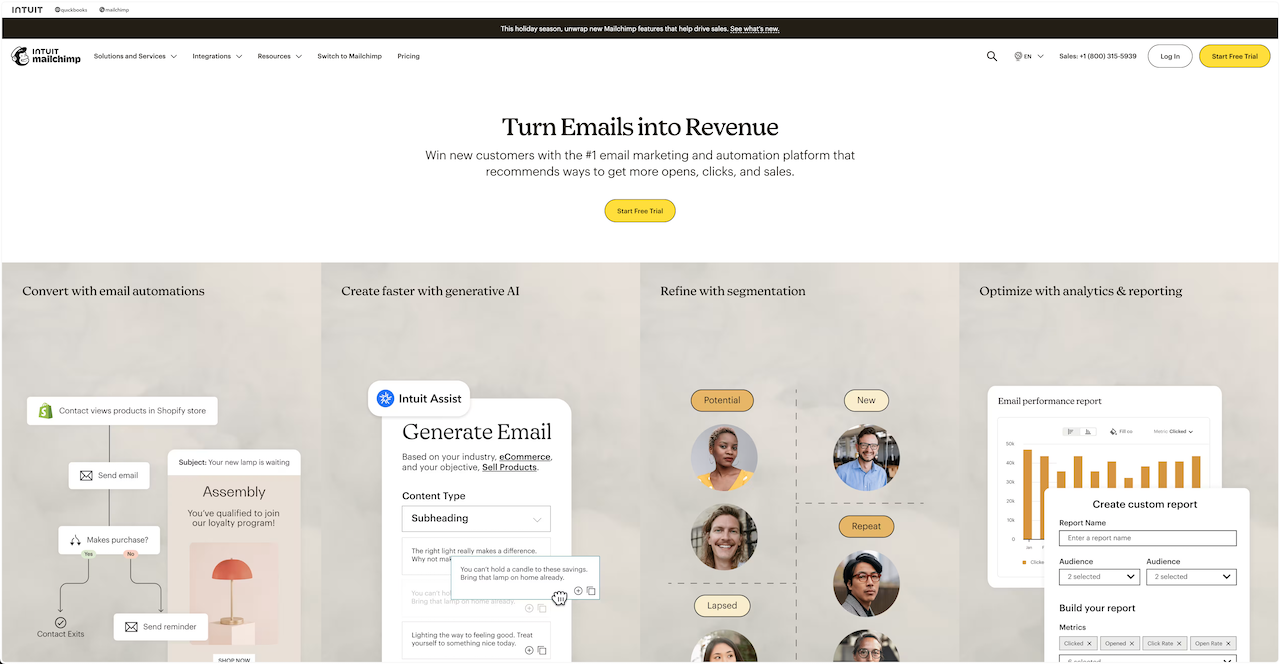
Mailchimp is the platform that introduced a generation of small businesses to email marketing, and it remains one of the most recognizable names in the space. Its email editor is intuitive, its template library is extensive, and its reporting tools give even first-time senders a clear picture of what's working4.
In recent years, Mailchimp has expanded beyond email to include a basic CRM, landing pages, social media posting, and a website builder. These additions make it a more complete tool than it once was, though it still lags behind dedicated CRM platforms in terms of sales pipeline management and automation depth. The platform's free plan allows up to 250 contacts and 1,000 monthly email sends, making it a reasonable starting point for very small businesses4.
The primary limitation of Mailchimp is that its pricing scales steeply with contact list size. The Standard plan, which includes automation and A/B testing, starts at $20 per month for 500 contacts but reaches $350 per month at 50,000 contacts4. For businesses with growing lists, the cost-per-contact model can become expensive quickly, and the platform's automation capabilities are less sophisticated than dedicated tools like ActiveCampaign or Bento.
Best for: Small businesses and solopreneurs who are new to email marketing and want a user-friendly platform with a low barrier to entry.
Pricing: Free plan available (250 contacts); Essentials from $13/month; Standard from $20/month; Premium from $350/month (all at 500 contacts, scaling with list size).
Zoho CRM: The All-in-One Suite for Budget-Conscious Teams

Zoho CRM is part of the broader Zoho ecosystem, which includes over 50 business applications covering everything from accounting and HR to project management and customer support. For businesses that want a single vendor relationship and a tightly integrated suite of tools, Zoho offers a compelling value proposition at a price point that is significantly lower than HubSpot5.
The CRM itself is feature-rich, covering contact and deal management, sales automation, workflow rules, email marketing, social media integration, and AI-powered analytics through Zoho's Zia assistant. The platform's customization options are extensive, allowing businesses to tailor the interface, fields, and workflows to their specific processes. Zoho CRM's Standard plan starts at $16 per user per month (billed annually), with the Professional plan at $27 per user per month and the Enterprise plan at $46 per user per month5.
The main criticism of Zoho CRM is that its interface can feel dated and the learning curve is steeper than more modern platforms. The sheer number of configuration options can be overwhelming for small teams without a dedicated administrator. However, for businesses that need a comprehensive, affordable CRM and are willing to invest time in setup, Zoho delivers exceptional value.
Best for: SMBs and growing businesses that need a wide range of CRM and business management features at an affordable per-user price.
Pricing: Free plan for up to 3 users; Standard at $16/user/month; Professional at $27/user/month; Enterprise at $46/user/month (billed annually).
Pipedrive: The Sales-Focused CRM

Pipedrive was built with one specific use case in mind: helping sales teams manage their pipeline and close more deals. The platform's visual pipeline interface is one of the most intuitive in the industry, making it easy for sales reps to see exactly where every deal stands and what action is needed next6.
Pipedrive's strength is its simplicity and focus. It doesn't try to be a full marketing platform or a customer support tool. Instead, it excels at deal tracking, activity reminders, email integration, and sales reporting. The platform's AI-powered sales assistant provides recommendations and alerts based on deal activity, and its reporting tools give managers clear visibility into team performance and pipeline health.
The trade-off is that Pipedrive's marketing automation capabilities are limited compared to platforms like ActiveCampaign or Bento. Email campaigns require an add-on, and the platform's automation is primarily focused on sales workflows rather than customer lifecycle marketing. For businesses that need both sales and marketing in one tool, Pipedrive may require supplementing with a dedicated email marketing platform6.
Best for: Sales-driven businesses and teams with a dedicated sales function that need a focused, easy-to-use CRM for pipeline management.
Pricing: Lite at $16/seat/month; Growth at $45/seat/month; Premium at $68/seat/month; Ultimate at $91/seat/month.
EngageBay: The Free All-in-One Alternative

EngageBay positions itself as the most direct HubSpot alternative for businesses that cannot afford HubSpot's pricing. The platform offers a free plan that includes CRM, email marketing, live chat, and helpdesk functionality for up to 250 contacts — a level of generosity that is unusual in the all-in-one platform space7.
The paid plans are also competitively priced. The Basic plan starts at $12.74 per user per month (billed annually) and supports up to 500 contacts. The Growth plan at $55.24 per user per month supports up to 50,000 contacts and includes marketing automation, landing pages, and push notifications. The Pro plan at $101.99 per user per month offers unlimited contacts and advanced features including web analytics, custom reporting, and single sign-on7.
EngageBay's feature set is impressive for the price, but the platform shows its limitations in design polish and automation sophistication compared to more established tools. The interface is functional but not as modern as Bento or HubSpot, and the automation builder, while capable, lacks the depth of ActiveCampaign. For startups and small businesses that need a broad feature set at a low cost, however, EngageBay is one of the best options available.
Best for: Startups and small businesses that need a free or very affordable all-in-one platform covering CRM, marketing, and support.
Pricing: Free plan available (250 contacts); Basic at $12.74/user/month; Growth at $55.24/user/month; Pro at $101.99/user/month (billed annually).
Brevo: The Multi-Channel Marketing Platform

Brevo (formerly Sendinblue) has carved out a distinct position in the market by offering email marketing, SMS marketing, WhatsApp campaigns, live chat, and a CRM under a single roof at a price point that undercuts most competitors. The platform's pricing model is based on email volume rather than contact list size, which makes it particularly cost-effective for businesses with large lists that send infrequently8.
Brevo's free plan allows unlimited contacts and up to 300 emails per day, making it one of the most generous free tiers available. The Starter plan at $9 per month removes the daily sending cap and allows up to 5,000 emails per month. The Standard plan, which includes marketing automation, A/B testing, and advanced reporting, starts at $18 per month8.
The platform's automation capabilities are solid for its price point, with pre-built goal-oriented workflows for common scenarios like welcome sequences, cart abandonment, and re-engagement campaigns. Brevo's SMS and WhatsApp integration is a genuine differentiator for businesses that want to reach customers across multiple channels without managing separate platforms.
Best for: Businesses with large contact lists that send campaigns infrequently, and those that want to combine email with SMS and chat marketing in one platform.
Pricing: Free plan available (unlimited contacts, 300 emails/day); Starter from $9/month; Standard from $18/month; Enterprise pricing on request.
At a Glance: HubSpot Alternatives Comparison
| Platform | Best For | Starting Price | Pricing Model | Standout Feature |
|---|---|---|---|---|
| Bento | Modern all-in-one for SMBs and SaaS | $30/month | Per user, all features included | Transparent pricing, AI CRM, unlimited emails |
| ActiveCampaign | Advanced marketing automation | $15/month | Tiered by contacts and features | Most powerful automation builder |
| Mailchimp | Simple email marketing | Free / $13/month | Tiered by contacts | Ease of use, strong template library |
| Zoho CRM | Affordable all-in-one suite | $16/user/month | Per user, tiered | Widest feature set for the price |
| Pipedrive | Sales pipeline management | $16/user/month | Per user, tiered | Best visual pipeline interface |
| EngageBay | Free all-in-one for startups | Free / $12.74/user/month | Per user, tiered | Most generous free plan |
| Brevo | Multi-channel marketing | Free / $9/month | By email volume | Email + SMS + chat in one platform |
How to Choose Your HubSpot Alternative
The right platform depends on what you actually need, not what sounds most comprehensive on a features page. Before evaluating any tool, it helps to be honest about a few key questions.
Start with your primary goal. Are you trying to manage a sales pipeline, run email marketing campaigns, automate customer lifecycle journeys, or all three? Platforms like Pipedrive are purpose-built for sales and will outperform general-purpose tools in that context. Platforms like Bento and ActiveCampaign are built around the full customer journey and will serve marketing-led businesses better.
Be realistic about your budget and how it scales. Most platforms look affordable at entry level. The real test is what you'll pay when your contact list reaches 25,000 or your team grows to ten people. Per-contact pricing models like Mailchimp's can become expensive quickly for businesses with large lists. Per-seat models like HubSpot's and Zoho's add up as teams grow. Bento's per-user model, capped at $0.01 per user per month, is one of the most predictable and scalable in the market.
Assess your team's technical capacity. Platforms like ActiveCampaign and Zoho CRM offer enormous depth, but that depth comes with a learning curve. If your team doesn't have a dedicated marketing operations person, a simpler platform that you'll actually use consistently will outperform a sophisticated one that sits half-configured. Bento and Mailchimp are both designed to be operational quickly, while Zoho and ActiveCampaign reward teams willing to invest time in setup.
Think about where you're going, not just where you are. A platform that works for 500 contacts and two team members may not work for 50,000 contacts and twenty. Evaluate pricing at your projected scale, not your current one, and look for platforms that offer a clear, predictable growth path without forcing you to renegotiate your contract every time you cross a threshold.
Why Now is the Best Time to Start With or Switch to Bento
If you've been living with HubSpot's pricing complexity, or you've been making do with a tool that's grown too limited for your needs, the case for switching to Bento has never been stronger.
The platform has reached a level of maturity that makes it a genuine enterprise-grade alternative, not just a budget option. Bento is now SOC-2 Type II compliant, meaning it meets the same security and data handling standards that enterprise buyers require from their vendors2. It offers dedicated IP addresses, deliverability consulting, and custom SLAs on its Enterprise plan — the kind of infrastructure that serious senders need and that many platforms charge significant premiums for.
On the value side, the numbers are difficult to argue with. At 10,000 users, Bento costs $100 per month. while Klaviyo costs $200 per month and ActiveCampaign costs $375 per month. Mailchimp costs $150 per month2. Unlike those platforms, Bento includes unlimited emails, unlimited automations, transactional email, shared inboxes, and an AI CRM in every plan — no add-ons, no feature gating, no surprises.
The migration process is also designed to remove the friction that keeps businesses stuck on platforms they've outgrown. Bento's team handles the full migration — contacts, templates, automations, and segments — typically within 24 to 48 hours. There are no long implementation timelines, no consultants to hire, and no risk of data loss. You can be fully operational on a better platform faster than it would take to schedule a sales call with most enterprise vendors.
Perhaps most importantly, Bento is built by a team that is genuinely invested in its customers' success. The Discord community, the direct access to founders, and the consistently high support ratings reflect a company culture that treats customer outcomes as a product metric, not an afterthought. That kind of relationship is rare in software, and it's the kind of thing that compounds in value over time.
The best time to switch was before you signed your last HubSpot contract. The second best time is now.
Start your free 30-day trial of Bento — no contracts, and full migration support included. Or book a demo to see exactly how Bento can replace your current stack and what you'll save in the process.
References
Footnotes
-
"Hubspot Pricing 2026: How to Avoid Paying Too Much," EmailToolTester. https://www.emailtooltester.com/en/crm/hubspot-review/pricing/ ↩ ↩2 ↩3 ↩4
-
"Pricing Plans - Email Marketing Software | Start Free with Bento," Bento. https://bentonow.com/pricing ↩ ↩2 ↩3 ↩4 ↩5
-
"ActiveCampaign Pricing 2026 - Don't Pay More Than You Need To," EmailToolTester. https://www.emailtooltester.com/en/reviews/activecampaign/pricing/ ↩ ↩2
-
"Mailchimp Pricing 2026: Watch Out for These Extra Costs," EmailToolTester. https://www.emailtooltester.com/en/reviews/mailchimp/pricing/ ↩ ↩2 ↩3
-
"Zoho CRM Pricing and Editions," Zoho. https://www.zoho.com/crm/zohocrm-pricing.html ↩ ↩2
-
"Pipedrive Pricing 2026 | Watch Out For These Extra Costs," EmailToolTester. https://www.emailtooltester.com/en/crm/pipedrive-review/pricing/ ↩ ↩2
-
"All-in-One Pricing Plans," EngageBay. https://www.engagebay.com/pricing/all-in-one ↩ ↩2
-
"Brevo Pricing 2026: Cheap, But With Extra Costs," EmailToolTester. https://www.emailtooltester.com/en/reviews/brevo/pricing/ ↩ ↩2

