



The average marketing technology stack contains over 10 applications.1 Email lives in one platform, SMS in another and chat somewhere else. Each tool creates its own data silo with its own workflows and pricing. Your marketing team spends more time switching between tools than actually marketing. Meanwhile, your customers get disconnected, fragmented experiences that feel like they're talking to different companies.
Real omnichannel marketing means your customer data actually talks to each other. Your messages coordinate across channels. Your workflows adapt based on how customers engage, not just what channel they prefer on paper. This guide covers platforms that deliver true multi-channel coordination, not just a list of features you'll never use.
TL;DR: Quick Picks by Business Type
For ecommerce stores: Klaviyo if you're deep in Shopify and need native ecommerce features. Omnisend for pre-built multi-channel campaigns that work out of the box.
For SaaS and digital products: Bento combines email, SMS, and chat with pay-per-send pricing. You store unlimited contacts but only pay when you message them. Deliverability tools included.
For enterprise teams: Braze for advanced personalization at scale. Salesforce Marketing Cloud if you're already locked into Salesforce.
For small businesses: ActiveCampaign balances power with simplicity. Mailchimp if you need basic multi-channel features without complexity.
What to watch out for: Many platforms charge separately for each channel. Some require minimum monthly SMS commitments. Check if deliverability tools cost extra, they often do.
Why Traditional Email Platforms Fall Short
Email platforms started as email platforms - then someone bolted on SMS. Push notifications came later and chat got added last week. Each addition technically works, but they don't work together.
Think about abandoned cart recovery. In a single-channel world, you send three emails and hope one works. With real omnichannel marketing, the sequence adapts. Customer opens the email but doesn't click? Switch to SMS. They click the SMS but don't buy? Show them an in-app message next time they visit. The channel changes based on what they do, not just a timer counting down.
Most platforms can technically send emails and SMS and push notifications, but the orchestration breaks down. Customer data stays fragmented between channels. Workflows run in parallel instead of talking to each other. You end up managing multiple campaigns that should be one conversation.
The pricing makes everything worse. You pay per contact for email, per message for SMS, per conversation for chat, and now you're managing three budgets, three sets of metrics, three different ROI calculations. The actual value gets lost in spreadsheet hell.
What Makes Real Omnichannel Software Different
Unified Customer Profiles
Real omnichannel platforms build complete customer profiles, not email engagement here and SMS responses there. Everything lives in one record: website visits, email opens, SMS replies, chat conversations, purchase history, support tickets. One view of each customer.
Customer.io does this well. Their profile view shows the complete journey across every touchpoint. You see the email that triggered the website visit that led to the SMS that closed the sale. One timeline showing everything.
Bento takes it further with behavioral scoring across channels. If a customer loves SMS but ignores email, the system learns and adapts. The data drives channel selection automatically, not some rules you set up six months ago and forgot about.
Intelligent Channel Selection
Good omnichannel software doesn't just let you pick channels. It helps you pick the right channel for each person at the right time.
Braze uses machine learning to predict the best send times and channels per customer.2 Some people buy from morning emails while others need an evening SMS nudge. The platform learns these patterns and adjusts without you micromanaging every decision.
Iterable offers channel optimization based on actual engagement. If someone hasn't opened an email in 30 days but clicked an SMS last week, the platform suggests SMS for the next campaign.3 Simple logic that most platforms make you figure out manually.
Workflow Orchestration
Single-channel automation follows simple if-then rules. Multi-channel orchestration needs more sophisticated logic to actually work.
ActiveCampaign handles complex workflows across channels without making you think too hard. Start with email. No engagement after 24 hours? Send SMS. They click but don't convert? Trigger a site message on their next visit. If they start a chat, pause everything and alert sales. It just works.
Bento makes this visual with workflow builders that show all channels together. Drag and drop actions for any channel. Set conditions based on any data point. The complexity stays under the hood where it belongs.
Consistent Messaging
Nothing kills customer experience faster than conflicting messages. Your email promotes one offer. SMS mentions a different one. Chat support has no idea what either message said.
Omnisend solves this with centralized content management. Create one campaign, then adapt it for each channel. The core message stays the same while the format changes. Email gets the full story. SMS gets the key point. Push notification creates urgency. Same campaign, different formats.
Klaviyo syncs promotional calendars across channels automatically. Running a Black Friday email campaign? The SMS and push notifications align without manual coordination. No more conflicting messages because someone forgot to update the SMS template.
Platform Comparisons: Who Does What Best
Klaviyo: Ecommerce Powerhouse

Klaviyo owns ecommerce omnichannel marketing for good reasons. Deep Shopify integration that actually works. Pre-built automation for every ecommerce scenario you'll face. Segmentation based on real purchase behavior, not just email clicks.
Strengths:
- Native ecommerce integrations (Shopify, BigCommerce, WooCommerce)4
- Segmentation using actual purchase data
- SMS and native web chat built into the platform5
- Revenue attribution that makes sense across channels
Limitations:
- Gets expensive fast as your list grows (contact-based pricing)6
- SMS costs extra per message on top of base price6
- Learning curve gets steep for advanced features
Best for: Ecommerce stores doing $50K+ monthly revenue who want sophisticated automation without hiring developers.
Bento: Value-Focused Flexibility

Bento is a contact-based email marketing and CRM platform built around a simple promise: one flat subscription, unlimited email sends, no per-message charges for email. The Starter plan is $30/month for up to 3,000 contacts; the Growth plan scales at $0.01 per contact per month with no tier jumps.[^23] Native web chat (Bento Chat) is included in all paid plans. SMS and WhatsApp are available through a Twilio integration, which requires a separate Twilio account.
Strengths:
- Unlimited email sends on every paid plan — no per-send charges[^23]
- Contact-based pricing that scales predictably without surprise tier jumps
- All features included in the price
- Deliverability infrastructure included by default (reputation monitoring, warm-up, authentication)
- Native web chat and shared inboxes included at no extra cost
- AI-powered CRM with behavioral scoring and engagement tracking
- Visual drag-and-drop workflow builder
- Great around-the-clock direct support
- SMS and WhatsApp via Twilio integration
Limitations:
- SMS and WhatsApp require a separate Twilio account and carry Twilio's per-message costs
- Smaller out-of-the-box template library than Klaviyo or Mailchimp
Best for: SaaS companies, digital product businesses, and growing ecommerce stores that want sophisticated email automation, native chat, and predictable pricing without enterprise complexity.
Customer.io: Developer-Friendly Orchestration

Customer.io builds for technical teams who want complete control. API-first design. Flexible data model. Powerful segmentation that developers actually like using.7
Strengths:
- Excellent API and developer tools
- Store any customer attribute you want
- Strong webhook support for custom integrations
- Visual workflow builder with code escape hatches
Limitations:
- Needs technical knowledge to set up properly
- Limited built-in templates
- SMS and push cost extra7
- Expensive for small teams
Best for: Technical teams building custom customer communication flows, especially SaaS and mobile apps.
ActiveCampaign: Small Business Balance

ActiveCampaign sits between simple and sophisticated. More powerful than Mailchimp. Less complex than enterprise platforms. Just right for many businesses.
Strengths:
- Good balance of features and usability
- Built-in CRM for sales alignment
- Predictive sending and content features8
- Reasonable pricing for what you get
Limitations:
- SMS requires separate add-on purchase9
- Deliverability tools only unlock at higher tiers
- Interface gets cluttered quickly
- Platform slows down with large lists
Best for: Small to medium businesses wanting sophisticated automation without enterprise complexity or cost.
Braze: Enterprise Orchestration

Braze targets enterprise brands with complex requirements. Billions of messages. Sophisticated personalization. Real-time everything. The works.
Strengths:
- Massive scale capabilities
- Advanced machine learning for optimization2
- Real-time personalization that actually works
- Canvas visual journey builder10
Limitations:
- Enterprise pricing (starts at $60K+ annually)11
- Takes months to implement properly
- Needs dedicated team to manage
- Overkill for 99% of businesses
Best for: Enterprise brands with dedicated marketing ops teams and genuinely complex multi-channel requirements.
Omnisend: Ecommerce Multi-Channel
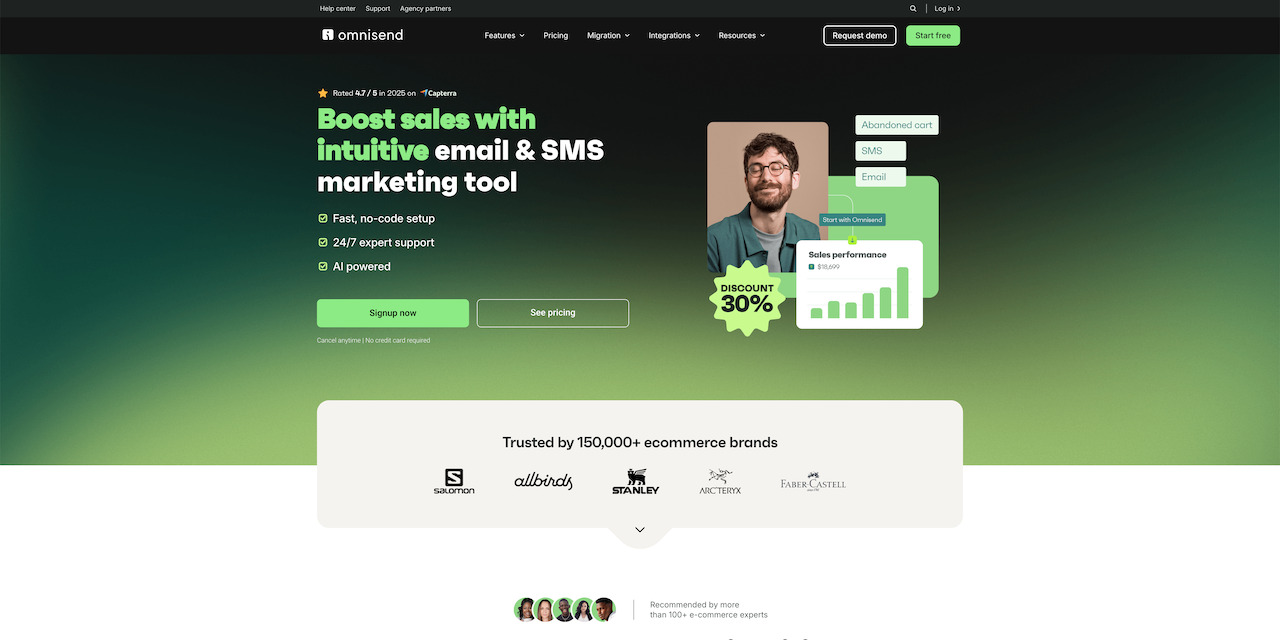
Omnisend focuses specifically on ecommerce omnichannel marketing. Pre-built workflows that work. Ecommerce-specific segmentation. Multiple channels from day one.
Strengths:
- Pre-built automation workflows for ecommerce
- SMS and push notifications included12
- Competitive pricing for multi-channel features
- Good template library
Limitations:
- WhatsApp integration requires a third-party tool13
- Less flexible than general-purpose platforms
- Basic API capabilities
- Reporting isn't as deep as competitors
- Really only works for ecommerce
Best for: Small to medium ecommerce stores wanting quick multi-channel setup without complex configuration.
Channel-Specific Considerations
Email Deliverability
Email stays the foundation of most omnichannel strategies. But deliverability determines if any of it matters. The best platform in the world is useless if your emails land in spam.
Bento has one of the highest deliverability levels in the industry. The platform includes deliverability infrastructure by default for all of the users: reputation monitoring, authentication setup, batch controls, warming schedules. Other platforms charge thousands extra for these features or make you buy third-party tools.
SendGrid (now part of Twilio) offers strong deliverability for transactional email but you need marketing supplements.14
Klaviyo and Customer.io provide good deliverability tools but at premium prices. ActiveCampaign only unlocks deliverability features at higher tiers, which feels like holding your emails hostage.
SMS Compliance and Costs
SMS comes with regulations email doesn't have. Opt-in consent requirements. Quiet hours. Message frequency limits. Keyword requirements. Mess this up and face real fines.
Attentive has expanded beyond its initial SMS focus to become a multi-channel platform including email and push notifications.15
Postscript offers deep SMS expertise for ecommerce, especially for Shopify stores.16
Most omnichannel platforms handle basic SMS compliance, but costs vary wildly. Some charge per segment (160 characters).17 Others charge per complete message. International SMS costs even more. Always factor SMS volume into your total platform cost, it adds up fast.
Chat and Messaging Apps
Chat creates different challenges. People expect real-time responses. Conversations need threading. Agents need handoff capabilities. Bots need integration points.
Intercom excels at chat and has robust email marketing capabilities, making it a strong contender for support-driven communication and marketing automation.18
Drift, now part of Salesloft, focuses on B2B sales conversations and lead capture.19
Full omnichannel platforms increasingly include chat, but depth varies. Bento offers unified conversations across email, SMS, and chat in one view. ActiveCampaign provides basic chat. Klaviyo now offers native web chat, a significant update from previously relying on third-party integrations.5
Push Notifications
Mobile push and web push expand reach beyond email and SMS. But implementation needs technical work. Mobile apps need SDKs installed. Websites need service workers configured.
OneSignal has evolved from a push notification specialist to a unified customer engagement platform that includes email and SMS.20
Airship offers sophisticated push for enterprises with big budgets.
Among omnichannel platforms, Braze and Customer.io handle push best. Good SDKs. Smart segmentation. Reliable delivery. Others treat push as a checkbox feature.
Integration Requirements
Ecommerce Platforms
Ecommerce stores need deep platform integration. Product catalogs, inventory levels, order status, customer segments. The integration quality determines what you can actually do.
Shopify: Klaviyo offers the deepest integration by far. Omnisend and Bento connect well. ActiveCampaign requires more configuration to work properly.
WooCommerce: Omnisend and ActiveCampaign integrate smoothly. Klaviyo's integration is also robust and officially supported.4
BigCommerce: Klaviyo and Omnisend offer native apps. Others connect through Zapier or API, which adds complexity.
CRM Systems
B2B companies need CRM alignment. Lead scoring, deal tracking, pipeline visibility. Your marketing platform needs to speak CRM fluently.
Salesforce: Marketing Cloud offers obvious integration. Pardot, now called Marketing Cloud Account Engagement, is tailored for B2B specifics.21
HubSpot: Has its own omnichannel capabilities. Third-party platforms integrate but you're duplicating features.
Pipedrive/Close: ActiveCampaign integrates well with both. Bento connects through API. Others vary in depth and reliability.
Analytics and Data Platforms
Sophisticated marketing needs data integration. Customer data platforms, analytics tools, business intelligence. The connections determine what insights you can actually get.
Segment: Customer.io and Braze integrate natively. Others need custom setup that may or may not work well.
Google Analytics: Most platforms pass campaign data. Depth varies significantly. Klaviyo and Bento offer rich ecommerce tracking that actually helps.
Mixpanel/Amplitude: Technical platforms like Customer.io integrate well. Others need engineering work to connect properly.
Pricing Models and Hidden Costs
Contact-Based Pricing
Most platforms charge based on stored contacts,even if they are not active. 10,000 contacts costs X. 50,000 contacts costs 5X. Sounds simple until you realize 70% of your contacts never engage with anything.
On the other side, you can usually send more emails this way, so if you prefer frequent emailing to your list, this pricing method will work well for you.
Hidden costs:
- Paying for dead contacts who never open anything
- List cleaning reduces your investment value
- Growing lists increases costs even if engagement stays flat
- SMS and other channels cost extra per message
Klaviyo, ActiveCampaign, and Mailchimp follow this model. Costs escalate quickly as lists grow, regardless of actual engagement.
Bento is based upon contacts, but you only pay for the ative ones SMS costs per message but from a lower base cost.
Usage-Based Pricing
Some platforms charge for what you send. Store unlimited contacts. Pay when you actually message them.
Customer.io offers hybrid pricing: base platform fee plus usage charges. It's m ore complex but can save money if you send targeted campaigns instead of blasting everyone.7
Channel Add-On Pricing
Many platforms price channels separately. Email costs X. Add SMS for Y. Include chat for Z. Before you know it, you're paying for features you thought were included.
ActiveCampaign: SMS requires separate purchase. Then you pay per message on top of that base cost.9
Klaviyo: SMS is charged per message sent, though push notifications are included for free in all plans.622
Omnisend: Includes all channels but limits message volumes. Exceed limits, prices jump significantly.12
Watch for these hidden costs:
- Minimum monthly SMS commitments you have to pay regardless of usage
- International SMS surcharges that can triple costs
- Chat conversation limits that reset monthly
- Push notification caps that force upgrades
Deliverability Infrastructure
Deliverability tools often hide in enterprise tiers or expensive add-on packages. But without them, nothing else matters.
Included by default: Bento, SendGrid (for transactional only)
Premium tier only: ActiveCampaign, Constant Contact
Separate add-on: Mailchimp (advanced features), some Klaviyo features
Poor deliverability wastes every dollar spent on marketing. Factor infrastructure costs into platform selection from the start.
Implementation Strategies
Start with Your Strongest Channel
Don't turn on every channel at once. Start where you have momentum. Got an engaged email list? Begin there. Strong SMS opt-ins? Launch that first.
Build your workflows in your primary channel. Test them. Optimize them. Then expand to additional channels. This phased approach reduces complexity and actually gets better results than trying to do everything at once.
Map Customer Journeys First
Before building campaigns, map out ideal customer journeys. New customer onboarding flow. Repeat purchase sequence. Win-back campaigns. Know where you're going before you start building.
Identify natural channel transition points. Welcome emails make sense, and order confirmations via SMS add value. Meanwhile, support questions need chat. Let the journey determine the channel, not what the platform salesperson told you.
Test Channel Preferences
Customers have preferences. Some love SMS updates. Others find them invasive. Some check email constantly. Others treat it like physical mail.
Test preferences explicitly. Ask during signup what they prefer. Include preference centers in your emails. Monitor engagement patterns. Let customers tell you how they want to hear from you.
Measure Incrementally
Multi-channel attribution gets complex fast. Did the email drive the sale? The SMS? Both? Neither? You'll drive yourself crazy trying to figure it out.
Start with incremental measurement instead. Run single-channel campaigns as control groups and compare them to multi-channel versions. The lift shows the actual value of orchestration. This is much simpler than trying to track every touchpoint.
Common Pitfalls to Avoid
Channel Bombardment
Just because you can message across every channel doesn't mean you should. Sending the same message via email, SMS, and push just annoys people into unsubscribing from everything.
Set frequency caps across all channels. If someone gets an email today, skip tomorrow's SMS. Respect their preferences. Quality beats quantity every time.
Ignoring Channel Strengths
Each channel has natural strengths: email handles long content well, SMS drives urgency and chat enables actual conversation.
Therefore, don't force channels to do things they're bad at. Don't send essays via SMS. Time-sensitive alerts shouldn't go via email. Automated chat responses when people need real help are not good idea. Play to each channel's actual strengths.
Siloed Teams
Marketing owns email, sales owns chat and support owns SMS. This organizational structure kills omnichannel execution before it starts.
Successful omnichannel needs coordination. Shared calendars. Unified reporting. Clear ownership. Fix the organizational silos before implementing platform solutions.
Underestimating Complexity
Omnichannel marketing multiplies complexity. More channels mean more workflows, more decisions, more potential failure points.
Start simple. Basic flows across two channels. Expand gradually. Build expertise over time. Complexity happens naturally. Simplicity requires discipline and saying no to shiny features you don't need yet.
Making Your Platform Decision
For Deliverability-Focused Teams
If email deliverability drives your success, prioritize platforms with built-in infrastructure. Bento includes everything by default. SendGrid excels for transactional but needs marketing supplements. Klaviyo offers good tools at premium prices.
Skip platforms that treat deliverability as an expensive add-on. Poor delivery wastes every other investment you make.
For Rapid Implementation
Need multi-channel marketing running fast? Omnisend offers pre-built ecommerce workflows that work immediately. ActiveCampaign balances features with usability. Mailchimp keeps things simple but limited.
Avoid platforms requiring extensive technical setup unless you have dedicated developers ready to help.
For Maximum Flexibility
Building custom experiences? Customer.io offers ultimate flexibility for technical teams. Bento combines flexibility with visual tools that non-developers can use. Braze handles enterprise complexity if you have enterprise budgets.
These platforms need more initial setup but adapt to any use case as you grow.
For Budget-Conscious Teams
Working with limited budgets? Bento's value-based pricing often costs less than contact-based models for the same results. ActiveCampaign offers good features per dollar. Omnisend stays competitive for multi-channel needs.
Calculate total costs including all channels, message volumes, and hidden fees. The cheapest base price rarely equals the lowest total cost.
Stop Paying for Platforms. Start Paying for Results.
The omnichannel promise was simple: talk to your customers in the right channel at the right time. The reality is you're drowning in complexity, juggling multiple platforms, and paying a fortune for contacts who haven't opened an email in months. Your marketing stack is working against you.
Klaviyo is powerful for Shopify, but its contact-based pricing punishes you for growing your list. Braze offers enterprise-grade orchestration, but demands enterprise-level budgets and a dedicated team to run it.
There is a better way.
Bento was built to deliver on the original omnichannel promise without the complexity and cost. It's a unified platform for email marketing, automation, native web chat, and CRM — built on a simple, radical idea: unlimited email sends, one predictable subscription.
With Bento, your subscription covers unlimited sends to your entire list. Send daily, send week, run a re-engagement campaign and a product launch in the same month - the price doesn't change. This isn't just a different pricing model; it's a fundamentally fairer way to do business that rewards you for actually using the platform.
But value is more than just price. It's about what you get for your money. While other platforms hide critical deliverability tools behind expensive enterprise tiers, Bento includes them by default. Reputation monitoring, IP management, and automated warm-up schedules—the entire infrastructure you need to actually hit the inbox—is built-in and ready to go from day one.
Imagine having a single view of your customer, where you can see every email open, every SMS click, and every chat conversation. Imagine building sophisticated, cross-channel workflows with a simple drag-and-drop editor. Imagine the system automatically learning which channel each customer prefers and optimizing for you.
That's Bento.
It's time to unify your customer communications and get back to what you do best: building relationships and growing your business. Start your free 30-day trial today or book a demo with our team.
Footnotes
-
HubSpot. (2026). 2026 Marketing Statistics, Trends, & Data. https://www.hubspot.com/marketing-statistics ↩
-
Braze. (n.d.). Intelligent Timing. https://www.braze.com/docs/user_guide/brazeai/intelligence/intelligent_timing/ ↩ ↩2
-
Iterable. (n.d.). Channel Optimization. https://support.iterable.com/hc/en-us/articles/13102589168916-Channel-Optimization ↩
-
Klaviyo. (n.d.). The Preferred WooCommerce Extension for Marketing Automation. https://www.klaviyo.com/platform-integrations/woocommerce ↩ ↩2
-
Klaviyo Help Center. (2026). Getting started with web chat. https://help.klaviyo.com/hc/en-us/articles/33660391549211 ↩ ↩2
-
Klaviyo. (n.d.). Klaviyo Pricing. https://www.klaviyo.com/pricing ↩ ↩2 ↩3
-
Customer.io. (n.d.). Pricing + Plans. https://customer.io/pricing ↩ ↩2 ↩3
-
ActiveCampaign. (n.d.). Predictive Sending to Increase Contact Engagement. https://www.activecampaign.com/platform/predictive-sending ↩
-
ActiveCampaign Help Center. (2025). Purchase the SMS add-on. https://help.activecampaign.com/hc/en-us/articles/23392070583068-Purchase-the-SMS-add-on ↩ ↩2
-
Braze. (n.d.). Customer Journey Orchestration Platform. https://www.braze.com/product/journey-orchestration ↩
-
Spendflo. (2025). Braze Pricing Plans in 2025. https://www.spendflo.com/blog/braze-pricing-guide ↩
-
Omnisend. (n.d.). Omnisend Email & SMS Pricing Plans Comparison. https://www.omnisend.com/pricing/ ↩ ↩2
-
Omnisend Support. (n.d.). Integrate Chatarmin WhatsApp Marketing Tool with Omnisend. https://support.omnisend.com/en/articles/9188374-integrate-chatarmin-whatsapp-marketing-tool-with-omnisend ↩
-
Twilio. (2019). Twilio Completes Acquisition of SendGrid. https://www.twilio.com/en-us/press/releases/twilio-completes-acquisition-sendgrid ↩
-
Attentive. (n.d.). AI-Powered SMS and Email Marketing Platform. https://www.attentive.com/ ↩
-
Postscript. (n.d.). SMS Marketing and Sales for Shopify Brands. https://postscript.io/ ↩
-
Twilio. (n.d.). What is the SMS Character Limit? https://www.twilio.com/docs/glossary/what-sms-character-limit ↩
-
Intercom. (n.d.). The #1 AI Agent and next-gen Helpdesk. https://www.intercom.com/suite ↩
-
Salesloft. (2024). Salesloft Acquires Drift. https://www.salesloft.com/company/newsroom/salesloft-acquires-drift ↩
-
OneSignal. (n.d.). Customer Engagement Platform for Email, Push.... https://onesignal.com/ ↩
-
Salesforce. (n.d.). Marketing Cloud Account Engagement Pricing. https://www.salesforce.com/marketing/b2b-automation/pricing/ ↩
-
Klaviyo. (n.d.). Drive engagement with mobile app marketing. https://www.klaviyo.com/products/mobile-app-marketing ↩

